

The Mathematical Gazette Book Pdf Download
We use cookies to distinguish you from other users and to provide you with a better experience on our websites. Close this message to accept cookies or find out how to manage your cookie settings.


- View selected items
- Save to my bookmarks
- Export citations
- Download PDF (zip)
- Send to Kindle
- Send to Dropbox
- Send to Google Drive
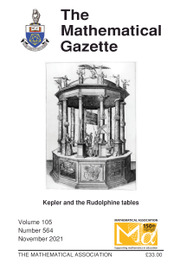
Volume 105 - Issue 564 - November 2021
Latest issue of The Mathematical Gazette
Contents
Articles
-
Pairing theorems about parabolas through duality
- Published online by Cambridge University Press: 13 October 2021 , pp. 385-396
-
- Article
-
- Get access
-
- Export citation
-
-
We investigate the pairing of theorems about parabolas through a dual transformation. Theorems and constructions concerning a parabola in a two-dimensional space can be in one-to-one correspondence with theorems and constructions concerning a parabola in the two-dimensional dual space. These theorems are called dual theorems.
-
-
Long medians and long angle bisectors
- Sadi Abu-Saymeh, Yaqeen Al-Momani, Mowaffaq Hajja, Mostafa Hayajneh
- Published online by Cambridge University Press: 13 October 2021 , pp. 397-409
-
- Article
-
- Get access
-
- Export citation
-
-
Following Euler, we denote the side lengths and angles of a triangle ABC by a, b, c, A, B, C in the standard order. Any line segment joining a vertex of ABC to any point on the opposite side line will be called a cevian, and a cevian AA′ of length t will be called long, strictly long, or balanced according as t ≥ a, t > a or t = a. If A′ lies strictly between B and C, AA′ is called an internal cevian. This convention regarding cevians is not universal, and it is, for example, in a heavy contrast with that in [1, p. 73].
-
-
The probability certain random quadratics have real roots
- Chris Boucher
- Published online by Cambridge University Press: 13 October 2021 , pp. 410-415
-
- Article
-
- Get access
-
- Export citation
-
-
Early in high school algebra, quadratics chosen as examples by teachers and textbooks alike tend to have integer coefficients and to factorise over the integers. This can give the misleading impression that such quadratics are the norm. As students progress into calculus and begin regularly seeing quadratics that are not as 'nice', we hope they become disabused of this notion. Indeed, even if the coefficients of the quadratic are integers, the probability that the quadratic factorises over the integers tends to zero as the range from which the integers are drawn grows (see [1]). But what if we ask about a behaviour less restrictive than factorising, say merely having real roots? This is the problem that concerns this Article.
-
-
Rectangles and spirals
- J. N. Ridley
- Published online by Cambridge University Press: 13 October 2021 , pp. 416-424
-
- Article
-
- Get access
-
- Export citation
-
-
Every reader knows about the Golden Rectangle (see [1, pp. 85, 119], [2, 3]), and that it can be subdivided into a square and a smaller copy of itself, and that this process can be continued indefinitely, converging towards the intersection point of diagonals of any two successive rectangles in the sequence. The circumscribed logarithmic spiral passing through the vertices and converging to the same point is also familiar (see [3, 4]), and is analogous to the circumcircle of a regular polygon or a triangle. The approximate logarithmic spiral obtained by drawing a quarter-circle inside each of the squares is equally well known [3, p. 64]. Perhaps slightly less familiar is the inscribed spiral, which is tangential to a side of every rectangle, like the incircle of a triangle or a regular polygon. It does not (quite) coincide with the spiral passing through the point of subdivision of each side, as discussed in [3, pp. 73-77]. The Golden Rectangle, its subdivisions, and the circumscribed and inscribed spirals are illustrated in Figure 1.
-
-
Johannes Kepler and his making of the Rudolphine Tables
- Mark J. Cooker
- Published online by Cambridge University Press: 13 October 2021 , pp. 425-432
-
- Article
-
- Get access
-
- Export citation
-
-
This Article is about the many complicated tasks that one mathematician had to carry out, and the barriers he had to overcome in order to publish one very important book in the history of applied mathematics.
-
-
Monotonicity of the midpoint and trapezium estimates for integrals
- G. J. O. Jameson
- Published online by Cambridge University Press: 13 October 2021 , pp. 433-441
-
- Article
-
- Get access
-
- Export citation
-
-
The 'midpoint' approximation to the integral
 $$\int_0^1 f $$ is
 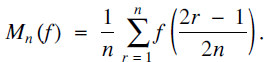 $${M_n}\left( f \right) = {1 \over n}\sum\limits_{r = 1}^n f \left( {{{2r - 1} \over {2n}}} \right)$$
 .
-
-
Linearly periodic continued fractions
- Kantaphon Kuhapatanakul, Lalitphat Sukruan
- Published online by Cambridge University Press: 13 October 2021 , pp. 442-449
-
- Article
-
- Get access
-
- Export citation
-
-
An infinite simple continued fraction representation of a real number α is in the form
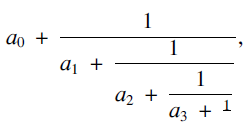 $$\eqalign{& {a_0} + {1 \over {{a_1} + {1 \over {{a_2} + {1 \over {{a_3} + {1 \over {}}}}}}}} \cr & \;\;\;\;\;\;\;\;\;\;\;\;\;\;\;\;\;\;\;\;\;\;\; \ddots \cr} $$
 where
 $${a_0}$$ is an integer, and
  $${a_i}$$ are positive integers for
  $$i \ge 1$$. This is often written more compactly in one of the following ways:
. $${a_0} + {1 \over {{a_1} + }}{1 \over {{a_2} + }}{1 \over {{a_3} + }} \ldots \;{\rm{or}}\;\left[ {{a_0};\;{a_1},\;{a_2},\;{a_3} \ldots } \right]$$
-
-
A pretty series revisited
- Seán M. Stewart
- Published online by Cambridge University Press: 13 October 2021 , pp. 450-457
-
- Article
-
- Get access
-
- Export citation
-
-
In the May 1954 issue of the Gazette Daniel F. Ferguson challenged readers to devise their own proof for what he described as a curious and somewhat pleasing sum (see [1])
-
-
Developing quadrature themes
- John D. Mahony
- Published online by Cambridge University Press: 13 October 2021 , pp. 458-466
-
- Article
-
- Get access
-
- Export citation
-
-
Readers will most likely be aware of the works of Johann Sebastian Bach in the field of music, particularly of his Goldberg variations and the changes that can be rung, wherein aesthetically appealing alterations to structure produce a raft of colourful sounding themes. Similarly in the field of quadrature it is possible to revisit and re-establish well-known formulae by developing variations on the theme of a three-point interpolating quadratic formed to represent a function that is to be integrated.
-
-
Verifying non-isomorphism of groups
- Des MacHale
- Published online by Cambridge University Press: 13 October 2021 , pp. 467-473
-
- Article
-
- Get access
-
- Export citation
-
-
The concept of isomorphism is central to group theory, indeed to all of abstract algebra. Two groups {G, *} and {H, ο}are said to be isomorphic to each other if there exists a set bijection α from G onto H, such that
 $$\left( {a\;*\;b} \right)\alpha = \left( a \right)\alpha \; \circ \;(b)\alpha $$ for all a, b ∈ G. This can be illustrated by what is usually known as a commutative diagram: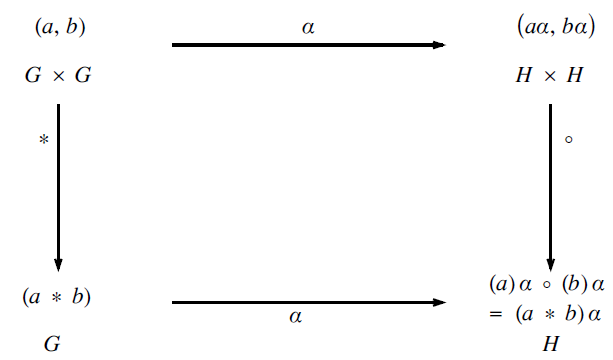
-
-
Some more properties of the bisect-diagonal quadrilateral
- Michael de Villiers
- Published online by Cambridge University Press: 13 October 2021 , pp. 474-480
-
- Article
-
- Get access
-
- Export citation
-
-
Martin Josefsson [1] has coined the term 'bisect-diagonal quadrilateral' for a quadrilateral with at least one diagonal bisected by the other diagonal, and extensively explored some of its properties. This quadrilateral has also been called a 'bisecting quadrilateral' [2], a 'sloping-kite' or 'sliding-kite' [3], or 'slant kite' [4]. The purpose of this paper is to explore some more properties of this quadrilateral.
-
-
Aesop's moral on success
- Edward J. Allen
- Published online by Cambridge University Press: 13 October 2021 , pp. 481-489
-
- Article
-
- Get access
-
- Export citation
-
-
Aesop's Fables is an enduring collection of short stories with morals that is credited to Aesop, a slave who lived in early Ancient Greece about 2600 years ago. Undoubtedly many later ancient Greek philosophers such as Pythagoras, Socrates, Aristotle and Archimedes were told Aesop's fables in their youth. In a race described in 'The Tortoise and the Hare', one of the most famous of Aesop's fables, a tortoise, running in a steady constant manner, beats a hare that is racing irregularly. The lesson of the fable is often interpreted as 'slow but steady wins the race' or 'consistent, effective effort leads to success' (see [1]) and is applicable to many human activities. The fable illustrates the general problem of working toward an objective when the rate of work is either constant or varies randomly.
-
-
Expected length and probability of winning a tennis game
- Curtis Cooper, Robert E. Kennedy
- Published online by Cambridge University Press: 13 October 2021 , pp. 490-500
-
- Article
-
- Get access
-
- Export citation
-
-
The game of tennis has provided mathematicians with many interesting problems. In [1], the problem of finding the probability that a certain player wins a tennis tournament was studied. Gale [2] determined the best serving strategy in tennis. First, we assume Alice and Bob play a game of tennis using the standard (or Deuce/Ad) scoring system, without a tiebreaker, and that Alice serves the game. We also assume that the probability that Alice wins any point she serves is . Stewart [3] proved that the probability that Alice wins is
 $${{15{p^4} - 34{p^5} + \;28{p^6} - 8{p^7}} \over {1 - 2p\; + \;2{p^2}}}$$
 .
-
-
A triangular exploration
- Prithwijit De, Gerry Leversha
- Published online by Cambridge University Press: 13 October 2021 , pp. 501-506
-
- Article
-
- Get access
-
- Export citation
-
-
In this Article we study the following problem: Let ΔABC be an acute-angled triangle. Let the points D, E, F on the sides BC, CA and AB, respectively, be such that AD is the median from A, BE is the internal angle bisector of ∠ABC, and CF is the altitude from C. This is shown in Figure 1.
-
Matter for debate
-
Correct answer – dodgy method
- Des MacHale
- Published online by Cambridge University Press: 13 October 2021 , pp. 507-510
-
- Article
-
- Get access
-
- Export citation
Notes
-
105.39 The Eureka theorem of Gauss
- Stan Dolan
- Published online by Cambridge University Press: 13 October 2021 , pp. 512-514
-
- Article
-
- Get access
-
- Export citation
-
105.40 A tale of two cubics
- Prithwijit De
- Published online by Cambridge University Press: 13 October 2021 , pp. 514-516
-
- Article
-
- Get access
-
- Export citation
-
105.41 Topology haiku matrix
- Josh Hiller
- Published online by Cambridge University Press: 13 October 2021 , p. 516
-
- Article
-
- Get access
-
- Export citation
The Mathematical Gazette Book Pdf Download
Source: https://www.cambridge.org/core/journals/mathematical-gazette/latest-issue
Posted by: lemosstrught.blogspot.com
0 Response to "The Mathematical Gazette Book Pdf Download"
Post a Comment